Torque, Horsepower, and Weight: Why Numbers Don’t Tell the Whole Story
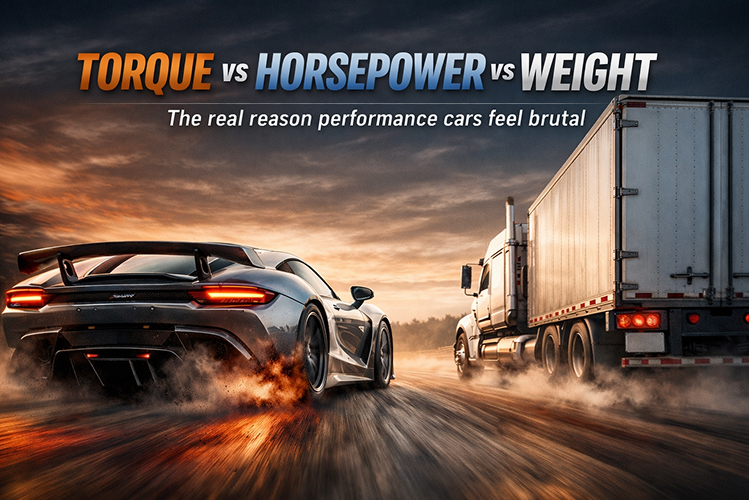
Every car enthusiast knows the numbers: torque, horsepower, and weight. They’re quoted in specs, debated in forums, and bragged about at meet-ups. But what really matters isn’t the numbers themselves — it’s how they interact.
This is the difference between a car that feels quick and one that feels violent.
On paper, they can look the same. From the driver’s seat, they never do.
Torque: The shove you feel
Torque is the twisting force your engine produces. It’s what you feel in your chest when you floor it.
| Class | Torque | Feeling |
|---|---|---|
| Mini | 100 Nm | gentle |
| Normal car | 250 Nm | solid |
| Performance | 450 Nm | strong |
| Supercar | 700 Nm | violent |
| Hypercar | 1200+ Nm | brutal |
| F1 | ~600 Nm | razor sharp* |
*F1 feels extreme because of low weight and high power, not peak torque alone. More on this later
This is why EVs feel so dramatic: Their instant torque means instant shove.
How engines create torque
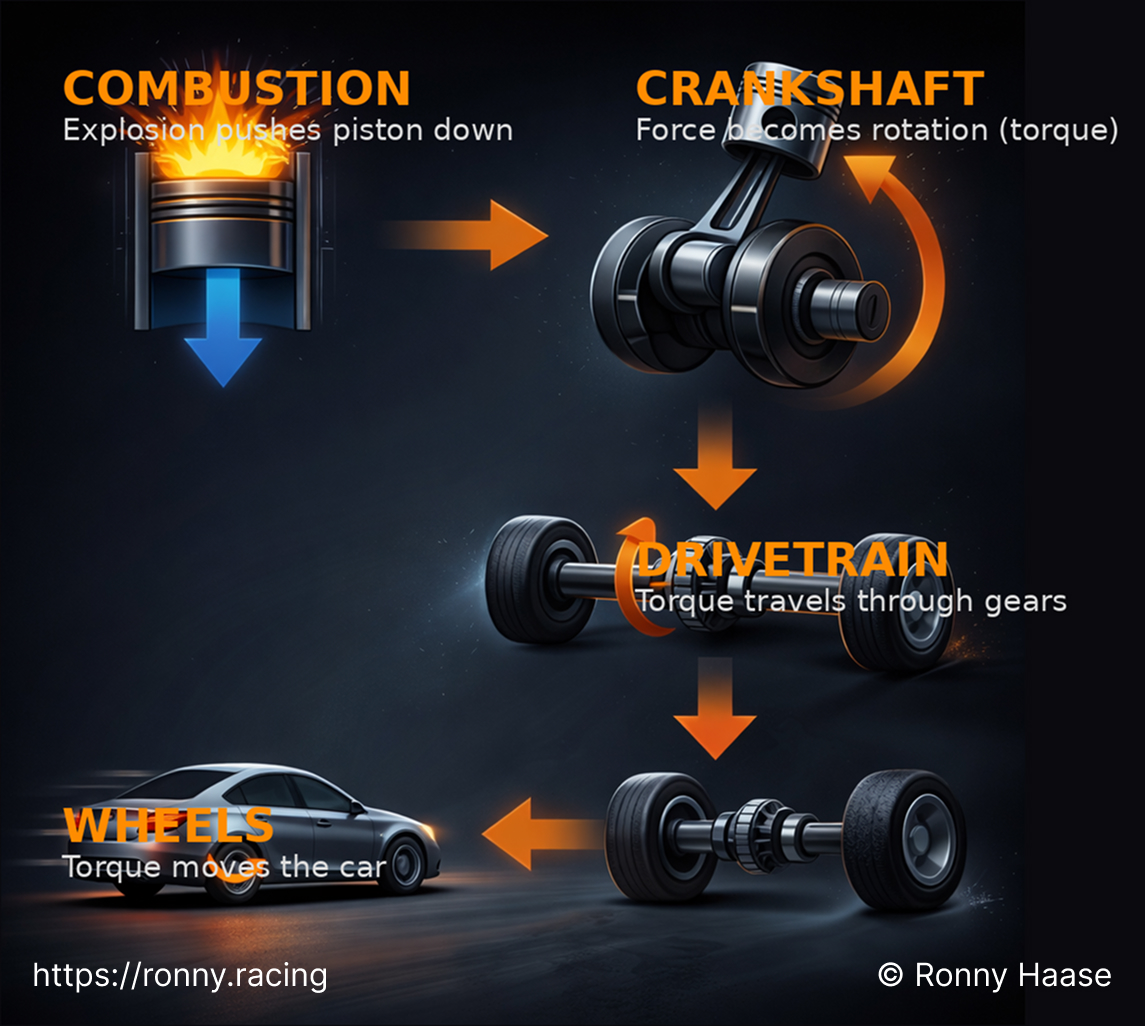
Torque is generated by combustion inside the cylinders. When the air–fuel mixture ignites, it forces the piston downward with enormous pressure.
That piston is connected to the crankshaft. As it moves down, it turns the crankshaft, converting the straight motion into rotational force. From there, the crankshaft sends that twisting force through the drivetrain to the wheels. Every explosion creates a twist. That twist is torque.
The harder the combustion pushes, the more torque is created. This is why turbocharged engines produce more torque — they increase pressure inside the cylinder.
Why EV torque feels different
Electric motors produce torque differently from combustion engines.
In a gasoline engine, torque builds with RPM. The engine has to spin faster before it reaches its peak force. That’s why traditional cars often feel stronger as revs climb.
Electric motors don’t have that delay.
They deliver maximum torque from zero RPM. The moment you press the accelerator, the motor can apply nearly its full twisting force to the drivetrain. There’s no waiting for revs, turbo boost, or gear changes.
This is why many EVs feel so explosive off the line. Even with similar power figures, the instant delivery of torque makes the initial acceleration feel far more aggressive.
The physics isn’t different — the timing is.
Why gearing makes torque feel bigger
The torque produced by the engine isn’t what reaches the wheels. The transmission multiplies it.
In first gear, wheel torque can be 10× higher than engine torque. This is why even modest engines can launch hard, and why lower gears feel so aggressive.
Gearing is force multiplication.
But torque alone doesn’t decide everything! Because torque has an enemy...
Weight: The silent killer
Weight absorbs acceleration.
A truck can produce 3000 Nm — four times a supercar — and still accelerate slowly. Why? Because it weighs 20 to 30 times more.
Meanwhile, a lightweight sports car with half the torque can feel far more explosive.
Less mass. Less resistance. More violence.
Simple physics. Huge difference.
Horsepower: The force that keeps pulling
If torque starts the punch, horsepower keeps it going. Torque gets you moving. Horsepower keeps the acceleration alive at higher speeds.
This is why high-revving engines feel different. They may have less torque, but strong horsepower keeps the car pulling harder and harder.
It’s the difference between a single hit and a sustained assault.
Horsepower isn’t separate from torque — it’s derived from it. Specifically, horsepower is a function of torque and engine speed (RPM). More torque at higher RPM equals more horsepower.
The real king: Power-to-weight ratio
This is the number that truly predicts performance.
Power divided by weight.
Examples:
- Family car: ~0.10 hp/kg — normal
- Sports car: ~0.30 hp/kg — fast
- Supercar: ~0.50 hp/kg — extreme
- Formula 1: ~1.25 hp/kg — absurd
- Porsche 911 Turbo S: 650 hp, 1640 kg → 0.40 hp/kg
- Tesla Model X Plaid: 1020 hp, 2480 kg → 0.41 hp/kg
This is why a 500 hp lightweight sports car can keep up with a 1000 hp SUV. And why Formula 1 cars feel like they break reality.
The takeaway
Torque determines how hard you’re hit.
Horsepower determines how long it lasts.
Weight determines whether it feels brutal or slow.
Get all three right, and you don’t just get speed. You get drama. And that’s what we enthusiasts really care about, right?